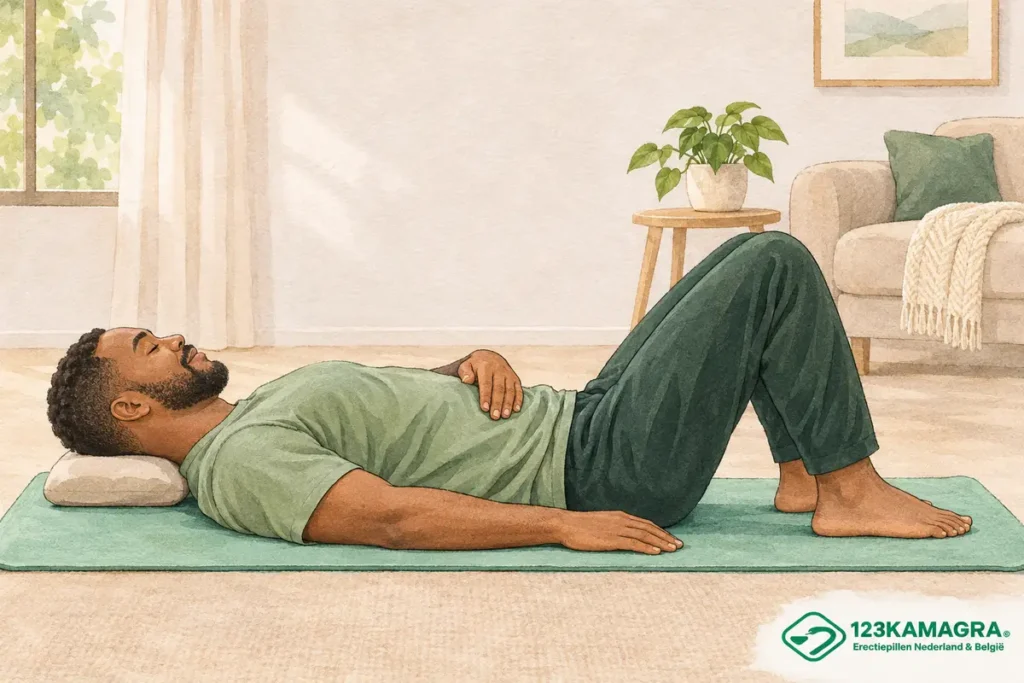
Coping with erection problems: advice for you and your partner
Coping with erection problems starts with making room for what you are experiencing. Talk about it, take the pressure off performance and ask your GP to help investigate recurring difficulties. You do not have to solve this alone.
You want to be close to someone, but your penis is not cooperating. That can knock your confidence. Perhaps you avoid sex, worry about the next time or struggle to explain what is happening. Those feelings deserve attention too.
This guide offers practical starting points: honest conversations, fewer comparisons, less pressure and attention to your health. There is advice for you and your partner, but you do not need a partner to find it useful.
Where should you begin? Choose the section that fits your situation. You do not have to tackle everything at once.
Dutch article updated: 14 October 2026
English version: 4 November 2026
Practical advice from our original article, supported by medical sources. See the sources.
An erection problem does not mean you have failed
Difficulty getting or keeping an erection from time to time is common. One experience does not automatically mean you have erectile dysfunction. Recurring difficulties deserve attention, particularly when they trouble you or affect your relationship.
An erection involves arousal, nerves, hormones and blood vessels. Thoughts and feelings play a part as well. Your body may therefore respond differently from what you expected. That does not make you less of a man or reveal how much you care about your partner.
Sexual desire, an erection and ejaculation are different things. You can want intimacy without getting an erection, and an erection does not automatically mean that you want sex. Our Dutch article on libido explores that distinction. Medicines for erection problems do not create desire or replace sexual stimulation.
How common are erection problems?
You are not alone. But statistics depend on the question being asked. Reporting a difficulty is different from experiencing it often and finding it very distressing.

Erection problems: three ways of measuring the same subject
Results from the Dutch Sexual Health Monitor 2023.
30%
Reported an erection problem
During a period of at least three months in the previous year.
5%
Often or always
Reported that the erection problem occurred often or always.
4%
Frequent and distressing
Often or always, with considerable or severe distress.
A percentage does not decide whether your experience is important enough to discuss. Worrying about it is a good enough reason to ask for help. Our Dutch article on Viagra and erection-medicine use addresses a different question: using medication is not the same measure as experiencing erection problems.

1. Talk about it with your partner
When you feel insecure, avoiding the subject can seem easier. You say you are tired, pull away or make a joke. Meanwhile, your partner may not understand what is happening.
You do not need a perfect explanation. Start with what you notice and what would help. Choose a calm moment outside the bedroom, without the expectation that you must immediately find a solution.
Talking about feelings is not a sign of weakness. It gives both of you a chance to understand the situation rather than filling in the gaps with assumptions.
What could you say?
I keep checking whether it is going to work, and that makes me anxious. I would like to talk about it without trying to fix everything right now.
Or keep it simpler: I want to be close to you, but I feel pressure about my erection. Could we find out together what feels good? Use words that sound like you. One conversation does not have to cover everything.
Ask how your partner feels as well. They might feel worried, frustrated or relieved that you have brought it up. Listen before rushing to explain. Honest conversation can help understanding, but it is not a guarantee that a physical symptom will disappear.
Reading this as a partner?
Listening is often a kinder starting point than a list of fixes. You could ask whether your partner wants ideas or simply wants to talk. Your own feelings matter too. Neither of you needs to pretend that the difficulty means nothing.
Our Dutch guide to supporting a partner with erection problems focuses on that connection. For a new relationship, the Dutch article on erection problems with a new partner offers more context. Try to find language that does not blame either person.
2. Stop measuring your sex life against other people’s
Stories from friends, pornography and social media can make it seem as though everyone else always wants sex and never has a difficulty. You cannot see what happens outside the story or the frame.
Our Dutch article on pornography and erection problems discusses expectations and viewing habits. If you compare how long an erection lasts, read the Dutch guide to erection duration. There is no required number of minutes that makes someone a good partner.
The same goes for body size. A research average is not a performance target; see our Dutch explanation of penis measurements. And there is no health quota for sex either, as our English article Is sex good for you? explains.
A more useful question is: do we feel safe, can we explain what we enjoy and are we free to stop? That says more about your experience than a comparison with someone else.
You might agree that penetration is not the goal next time. Kissing, cuddling and touch can be enjoyable in their own right, as long as you both want them. Time together need not become a test to prove that your erection is back to normal.
Not in a steady relationship? You decide how much to share. Saying that you feel nervous and would like to take things slowly can be enough. You do not owe anyone a performance or a detailed medical history.
3. Ease stress and performance pressure
Just relax is easy to say and often unhelpful to hear. You cannot switch tension off on command. You can, however, notice when you are checking your body rather than enjoying what you feel.
You may think: I hope it works this time. Then you keep monitoring your penis, which can add to the tension. Recognise the pattern without blaming yourself. Perfect relaxation is not another task to get right.
Make the next intimate moment less loaded
A gentle massage may be a useful starting point when you both want it. Our Dutch massage guide includes ideas for shoulders, back and hands. Agree on what you both find comfortable beforehand.
- Talk about expectations. What would feel good, and what is off the agenda today?
- Allow pauses. You may change your mind, laugh or do something else.
- Ask about the experience. What felt nice is a different conversation from why did it fail again.
- Get support when you feel stuck. A qualified sex therapist can help with recurring anxiety, overthinking or avoidance.
Long-term overload deserves attention outside the bedroom too. Our Dutch article on intimacy after burnout discusses taking things gradually and talking with your partner.
4. Pay attention to your health and possible causes
Erection problems can involve physical and psychological factors, often together. Avoid deciding for yourself that it is all in your head, or only a physical issue.
| Area | Examples |
|---|---|
| Physical health | Diabetes, high blood pressure, cardiovascular disease, hormonal or neurological conditions, and effects of surgery. |
| Feelings and circumstances | Stress, low mood, performance anxiety, relationship difficulties or upsetting experiences. |
| Medicines and substances | Some medicines have sexual side effects. Smoking, heavy alcohol use and recreational drugs may also play a part. |
Recurring difficulties can be a reason to review your general health. Your GP can decide which assessment is appropriate. Do not stop prescribed medicine yourself because you suspect a link.
Look at habits without blaming yourself
Physical activity, not smoking and attention to alcohol can be part of the approach. Healthier habits do not guarantee a particular erection, though. You do not need to reach an jouw bank weight or perfect routine before asking for help.
Start with something manageable: a walk in your day, for example, or a conversation about support to reduce drinking. Our Dutch articles on lifestyle and erection problems and alcohol, smoking and drugs explore those subjects.
When should you see your GP?
Arrange an appointment when the difficulty keeps returning, worries you or affects your sex life. You do not have to wait months or try every online tip first. Mention new pain, changes to your penis or symptoms that began after a new medicine.
Your GP is used to questions about sexuality. You can simply say: I find this awkward, but I am having trouble getting or keeping an erection. You do not have to know the cause before the appointment.
Useful things to write down
- When it started, and whether the change was sudden or gradual.
- Whether it happens in every situation or only some.
- Changes in desire, morning erections, pain or ejaculation.
- Medicines, supplements, alcohol and other substances you use.
- What you would like to improve and the questions you want answered.
You can attend alone or bring your partner. A longer appointment may help when there is more to discuss. Thuisarts offers advice on preparing for this conversation.
When is urgent help needed? An erection lasting four hours or longer requires immediate medical attention. Contact urgent medical services or your GP’s out-of-hours service straight away. Do not let embarrassment delay care.

What support is available for erection problems?
There is no single approach that suits everyone. The cause, your health and your preferences all matter. Explain what improvement means to you: less anxiety, more intimacy, easier erections or a combination.
Conversations and counselling
A sex therapist or psychologist can help with performance anxiety and difficulties around intimacy. A partner can be involved when you both want that. Counselling may also take place alongside medical treatment.
Addressing physical factors
Sometimes an underlying condition or a medicine review needs attention. Your clinician can discuss suitable changes and alternatives. Do not change a prescribed treatment on your own.
Prescription medicines for erectile dysfunction
Sildenafil and tadalafil are examples of medicines prescribed for erection problems. A doctor assesses whether a treatment is suitable, and a pharmacist checks issues such as interactions. Sexual stimulation remains necessary; the medicine does not automatically create desire.
Do not combine these medicines with nitrates or poppers. Blood pressure can fall dangerously. Do not increase the dose or combine erection medicines on your own.
Read our English comparison of sildenafil and tadalafil and the Farmacotherapeutisch Kompas information on erectile dysfunction. Product authorisation and prescribing decisions require more than comparing brand names.
Other options with a specialist
When appropriate, a urologist can discuss options such as a vacuum device or injection treatment. A penile implant is considered in selected circumstances. LUMC describes different treatments. The choice requires individual guidance.
Choose one first step
You do not need a complete action plan after reading this. Choose one step that feels manageable.
- Open a conversation. Tell your partner what you have noticed and ask for time to discuss it calmly.
- Drop one expectation. Agree that your next intimate moment does not need to be a test.
- Book an appointment. Write down your questions and contact your GP when the difficulty recurs or concerns you.
The aim is not to do everything perfectly tomorrow. It is to avoid being left alone with your worries and to find help that fits your circumstances.

Common questions about coping with erection problems
Can erectile dysfunction improve?
It depends on the cause. Temporary difficulties may resolve, while others benefit from treatment or support. One experience cannot predict the outcome. Discuss recurring symptoms with a healthcare professional.
Does an erection problem mean my partner is not attracted to me?
You cannot conclude that from an erection alone. Desire and erections are not the same thing. Ask about your partner’s experience instead of guessing. Relationship concerns can be discussed too.
Do I need to improve my lifestyle before seeking help?
No. Asking for support and working on habits can happen together. You do not have to complete a checklist to have your concern taken seriously.
Can I have morning erections and still have erection problems?
Yes. Morning erections are useful information for a clinician, but do not rule out every cause. They are not a home test that can separate physical from psychological difficulties.
Are erection tablets always the answer?
No. Medication is one option. Counselling, treatment of an underlying condition or a combination of approaches may be more appropriate. Discuss the options and realistic expectations with your doctor.
Sources and editorial note
This guide builds on our original Dutch article from 2020, updated on 14 October 2026. The English version was prepared on 4 November 2026. The practical advice focuses on communication, comparisons, pressure and health. The figures concern the Netherlands, not the whole population of Belgium. This is general information and does not replace personal medical advice.
- Rutgers: Sexual Health Monitor 2023, tables 8.1.1–8.1.3
- Thuisarts: erection difficulties
- Thuisarts: options for improving erections
- Thuisarts: discussing sexual concerns with your GP
- European Association of Urology: erectile dysfunction guideline
- Farmacotherapeutisch Kompas: erectile dysfunction
- LUMC: erection problems and treatments
Explore more in our English knowledge centre.

Dr Rogier J L – 123Kamagra ©
[ED] Apotheker | Seksuoloog
Gespecialiseerd in behandling van erectieproblemen, erectiepillen & seksuologie.
Meer over onze expertise
Transparantie vinden wij belangrijk. Meer achtergrondinformatie over expertise, visie en professionele context vind je via ons LinkedIn-profiel.
BIG
(BIG-nummer: 79926570317)
Erectiepillen Apotheek – Nederland & België
Jouw erectie, onze zorgen – Dat is ons motto.
Ons doel is een bijdrage te geven aan de samenleving. Onze morele ambitie ligt dan ook bij het verhelpen en oplossen van erectieproblemen. Een gezond seksleven is een belangrijk onderdeel voor een gelukkig en vitaal leven. Hier dragen wij graag een steentje aan bij. De taboe doorbreken met feitelijke medische informatie over erectiepillen, seks en erectieproblemen. We proberen alles te schrijven in menselijke taal, zodat iedereen de inhoud van deze onderwerpen kan begrijpen en toepassen.
Onze service
- Privacy Proof
- Discreet met persoonsgegevens – anoniem
- Legale erectiemiddelen
- Discrete Verzending
- Voordelige Sildenafil, Tadalafil en Dapoxetine erectiemiddelen
- 100% Levergarantie
Disclaimer: Veilig & verantwoord erectiepillen gebruiken
Heb je nog geen ervaring met het gebruik van erectiepillen? Vraag altijd om medisch advies aan jouw huisarts. De erectiemiddelen die wij aanbieden zijn medicijnen. Je hebt hier dus een doktersrecept voor nodig. Lees jezelf goed in over de werkzame stoffen: Sildenafil, Tadalafil & Dapoxetine. Wij zijn het informatieplatform voor erectieproblemen, erectiepillen en seks. Een beter seksleven begint bij 123kamagra!
Meer informatie is te vinden op de productpagina’s en onze blogs / artikelen. Ook kan je even een kijkje nemen op onze erectiewijzer – keuzehulp.
Of lees: Erectiepillen voor beginners
Andere artikelen
Meer lezen is meer weten! Wij houden van kennis, en dit met jou te delen. Ons specialisme is over de onderwerpen: Erectiepillen, erectieproblemen, erectiestoornissen, sildenafil, tadalafil of andere onderwerpen over seks en liefde?
Lees ons ruim aanbod van artikelen, blogs en opiniestukken. We hebben enorm veel tips om jouw seksleven en libido een boost te geven. Ons doel is jouw seksleven op pijl te krijgen.
Want seks maakt iedereen gelukkig, en dat maakt ons ook gelukkig. Ontdek onze zeer gevarieerde tips om beter te presteren in bed en de liefde met een glimlach te bedrijven. Verras jouw partner met romantiek, een betere erectie of een nieuwe prestatie in bed. Liefde gaat niet alleen om seks, maar ook o